
 Support
Network Exposure & Lateral Movement
Traditional VPNs extend network access broadly and allow lateral movement when credentials are compromised, unlike zero trust remote access solutions.
Why Conventional Remote Access Falls Short
Traditional VPNs extend network access broadly and allow lateral movement when credentials are compromised, unlike zero trust remote access solutions.

Hybrid work introduces unmanaged and variably secured endpoints into the access model, making consistent policy enforcement and governance increasingly difficult.

Hybrid work introduces unmanaged and variably secured endpoints into the access model, making consistent policy enforcement and governance increasingly difficult.

Multiple point products increase overhead and weaken consistency, especially in regulated environments that demand a unified zero trust network solution.
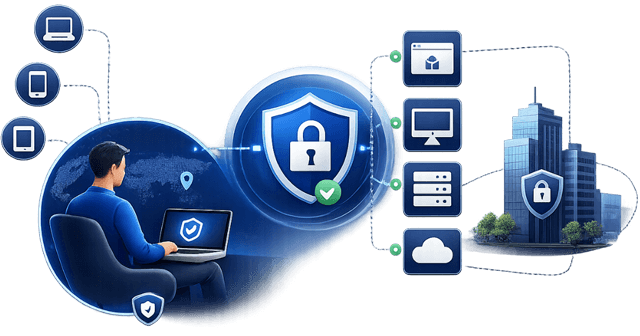
Keeps internal applications hidden by default.
Brokers access through per-application connectivity (not broad network access).
Enforces least-privilege with continuous validation as risk signals change.
Provides centralized visibility for governance, audit, and operations.











Employees and field teams can securely access internal applications from any network or device using zero trust access solutions, without broad network exposure.
Grant time-bound, application-scoped access to contractors, system integrators, and support vendors with full visibility and no exposure of critical internal network segments.
Extend access to personal or unmanaged devices using posture checks and policy-enforced session controls, with specific focus on reducing data leakage risk.
Maintain centralised visibility across all access activity with comprehensive logs of who accessed what, when, and from where to support compliance and governance.
Securely publish internal web applications for external users with application-layer protection and access controls that keep backend infrastructure hidden from the network.