
 Support
Endpoint-Centric Trust Assumptions
VPNs and identity-only access models implicitly trust vendor endpoints. Once connected, vendors operate within the enterprise environment using devices the organisation does not manage or continuously assess.
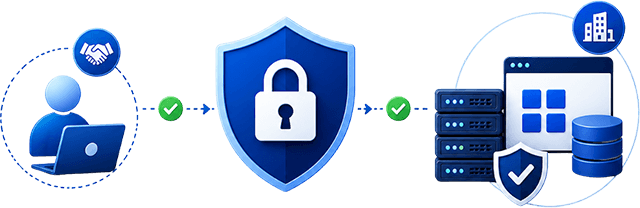

Traditional vendor access approaches struggle to address the realities of third-party access:
VPNs and identity-only access models implicitly trust vendor endpoints. Once connected, vendors operate within the enterprise environment using devices the organisation does not manage or continuously assess.

Most controls focus on entry. Governing copy-paste, screen capture, recording, downloads, or local transfers during live sessions remains inconsistent, especially across unmanaged devices.

Endpoint DLP and monitoring tools often rely on detection after exposure. In vendor scenarios, this provides limited assurance and weak audit defensibility.

Over-restricting access slows vendor productivity, while relaxed controls increase exposure. Striking the right balance remains difficult with fragmented tools.

Vendors often join and leave frequently. Managing third-party identities inside AD increases operational overhead and raises the risk of delayed deprovisioning.







Provide secure access to internal development tools and applications without leaving data traces on vendor devices, enabling collaboration without endpoint dependency.
Allow vendors to work from their own devices while keeping application execution and data handling within centrally governed workspaces.
Support vendor workflows where data capture, recording, or local storage is unacceptable, with enforceable session-level controls.
Rapidly onboard and offboard vendors with time-bound, role-specific access and automatic policy enforcement, while keeping identities local and MFA-bound to avoid AD overhead.